
Laurelwood’s Plant Collection Management System
An important aspect of the Arboretum’s Mission is to preserve Laurelwood Arboretum as an oasis for the enjoyment of nature. Complete and accurate plant records are a defining feature of arboreta and botanic gardens. A collection records management system comprises the mechanisms and processes of collecting, recording, tracking, and producing relevant information or data for the effective and efficient curation and utilization of the Arboretum’s collection of native and exotic trees, rhododendrons, and other woody plants. This system is an important and evolving resource, and built over time, becomes the Arboretum’s working memory and management tool.
Our Plant Collection Management Committee was established in 2014 to maintain, develop and interpret the Arboretum’s plant collections. With the assistance and guidance of our Horticultural Manager, this volunteer committee is responsible for the cataloging and tracking of trees, shrubs, rhododendrons, and other woody plants. The current documented plant collection contains approximately 2,200 trees, rhododendrons, and shrubs of over 200 native and exotic species. The committee’s efforts were recognized in 2017 by the Rutgers Master Gardener Association which awarded the plant collection management committee its Award of Excellence.
Computerized Database
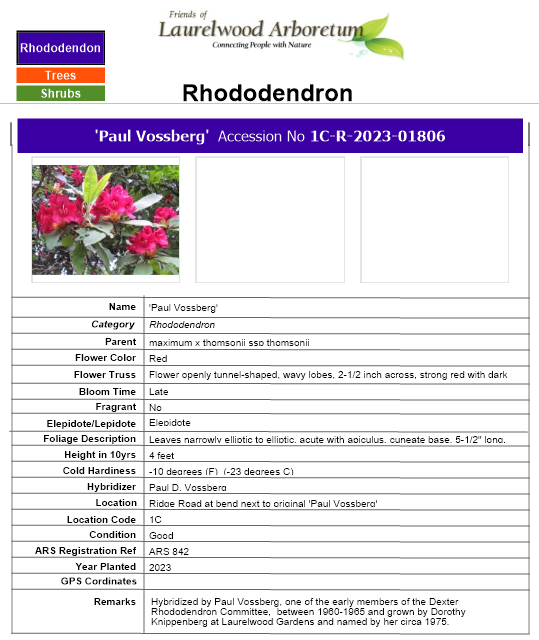
Our volunteer committee has developed a computerized database containing a detailed record for each plant that has been identified and cataloged. Each record contains the plant’s proper scientific name, common name, geographic origin, if applicable, location in the arboretum, year planted, photographs, accession number, and other detailed information. A sample record for the hybrid Rhododendron ‘Paul Vossberg’ is shown at the right.
Our Plant Collection Management Committee was established in 2014 to maintain, develop and interpret the Arboretum’s plant collections. With the assistance and guidance of our Horticultural Manager, this volunteer committee is responsible for the cataloging and tracking of trees, shrubs, rhododendrons, and other woody plants. The current documented plant collection contains approximately 2,200 trees, rhododendrons, and shrubs of over 200 native and exotic species. The committee’s efforts were recognized in 2017 by the Rutgers Master Gardener Association which awarded the plant collection management committee its Award of Excellence.
Computerized Database
Our volunteer committee has developed a computerized database containing a detailed record for each plant that has been identified and cataloged. Each record contains the plant’s proper scientific name, common name, geographic origin, if applicable, location in the arboretum, year planted, photographs, accession number, and other detailed information. A sample record for the hybrid Rhododendron ‘Paul Vossberg’ is shown at the right.
Plant Accession
Laurelwood Arboretum, like all museums and most arboreta, has developed a numbering system so that each plant can be treated as an individual. The unique accession number assigned to each plant record in our database corresponds to the 12-digit number on the anodized aluminum alloy plant hang tag affixed to trees, shrubs, rhododendrons, and other woody plants. Accession numbers are crucial for tracking plant materials, ensuring accurate records, and maintaining the integrity of botanical collections. They help in identifying plants, managing their history, and ensuring proper identification. Once a plant has been accessed, a temporary tag is affixed to the plant in the field. Permanent anodized aluminum alloy plant hang tags (shown below) are usually ordered in bulk once a year.
The accession number is comprised of a 12-digit number containing a two-digit plant location code, one-digit letter indicating plant type, four-digit year the plant was received or planted, and a unique five-digit number indicating the plant’s accession. For instance, the plant tag for Cornus kousa shown here includes the accession number 6E-T-2017-00894

indicating that it was added to the arboretum in 2017 and it was the 894th plant added to the plant collection database. Its location code, 6E, indicates it is located on the west side of Brook Road, and the letter “T” means it is a Tree. The permanent plant tag also includes the plant’s scientific name, shown in italic font, the common name, and the plant variety, ‘Wolf Eyes‘. The Arboretum’s staff and volunteer members of the plant collection management team can view the plant’s detailed record in our computer database by entering the unique five-digit number 00894 into our computer or the iPad in the field.
Plant Hang Tags
Plant tags are vital to the curation of the Arboretum’s plant collections. They are intended for use by the gardening staff to identify plants in the gardens during maintenance, inventory, and mapping. Not only are they a convenient way of providing information to the Arboretum’s staff, but they also link the individual plant to a record stored on the Arboretum’s computerized plant database. The tags are affixed to a branch, usually on the north side of the plant. In cases of large trees where affixing the hang tag to a branch is not practicable, the tag is mounted to a metal stake and placed next to the tree.
Plant Display Labels
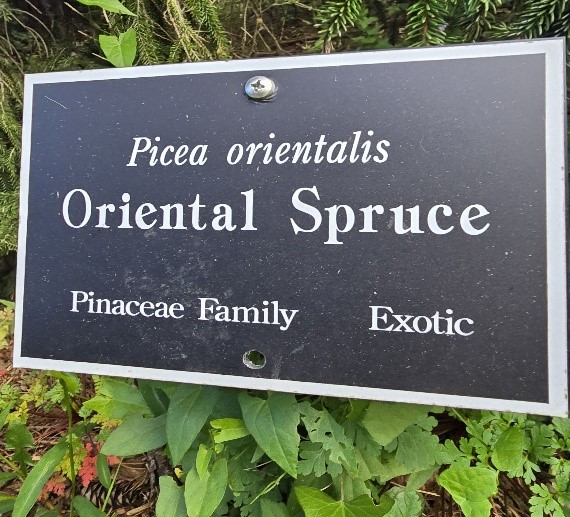
Plant display labels are intended to display educational information about the plant to visitors. Unlike hang tags, they are geared towards the public and face the front of a garden bed or path. These display labels include the verified scientific name, common name, family, and native or exotic designation of the identified plant. Currently, plant display labels are used for the Arboretum’s self-guided tree tour to identify 45 native and exotic trees on the tour. They are mounted to the tree’s bark using a small stainless-steel nail or screw and spring which compresses as the tree grows. Where mounting the sign on the tree is not possible, the display sign is mounted on an aluminum stake and placed in front of the tree as shown here.
A Management Tool
Our plant collection database is an important management tool. The plant collection management team maintains and updates the database monthly during the year. New plants added to the arboretum, and additional plants identified and cataloged, are added to the database each year The plant records in the database are used to produce management reports for the staff to create schedules for pruning and the replacement of dead or dying plants. Another important element of plant records management is documenting the identification, treatment, and impacts of pests and diseases detected in the Arboretum. This information is an important element in our Integrated Pest Management (IPA) Program.